Rewarding employees with shares: what will change for your business?
Attracting and retaining good staff is a challenge for many SMEs. A share option scheme can be an attractive alternative to a higher salary, but tax rules in the Netherlands have made this unnecessarily complicated for years. That is set to change. A new, more favourable scheme will come into force on 1 January 2027. What does this mean for you?
The current situation: paying tax without having the money
Since the legislative amendment of 2023, an employee has been required to pay tax the moment their shares become tradable, rather than only when they are actually traded. However, this was already a step forward, as prior to 2023 tax had to be paid upon the grant of the option; yet the core problem remained: the employee must pay tax on a paper profit that they have not yet realised. They hold the shares, but have no cash yet. In practice, this leads to two problems:
● The employee must dip into their savings or take out a loan to settle the tax bill.
● The tax rate is high: the proceeds are taxed under Box 1 (income tax), with a top rate of 49.5% for incomes above approximately €76,000.
The result: many employees choose not to participate, and employers view the scheme as an empty promise that delivers little in practice. The Netherlands therefore ranks a disappointing 20th out of 23 countries surveyed when it comes to the attractiveness of employee share ownership.
The new scheme from 2027: two crucial improvements
Minister Beljaarts of Economic Affairs has announced a major overhaul of the scheme with effect from 1 January 2027. There are two key changes:
1. The tax liability shifts to the moment of sale
Employees will in future only pay tax when they actually sell their shares and therefore receive the proceeds. There will no longer be tax on paper profits. This significantly lowers the threshold for participating in a share option scheme.
2. The effective tax rate falls to a maximum of approximately 32%
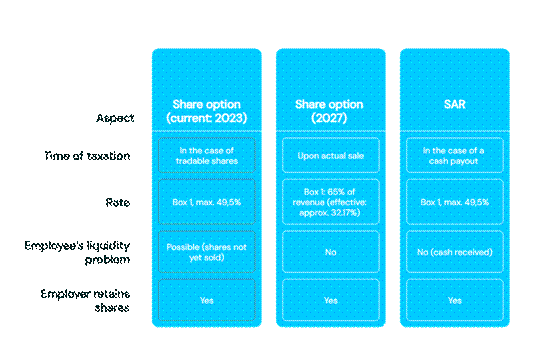
The tax base is narrowed: only 65% of the proceeds from the sale will be taxed in Box 1. The effective top rate therefore falls to approximately 32.17%, which is comparable to the Box 2 rate for income from a substantial interest. This represents a substantial reduction compared with the current top rate of 49.5%.
What does this mean for your business?
For the first time, the new scheme makes employee share ownership genuinely attractive for both employers and employees. For SME entrepreneurs, this offers the opportunity to:
● retain talent without immediately incurring higher wage costs;
● allow employees to share in the benefits of growth, which increases their commitment;
● compete with larger companies and foreign employers who are already making full use of this tool.
Is it worth taking action now?
The scheme will not come into effect until 2027, but preparation takes time. This includes drawing up or amending option plans, employment law agreements and shareholder agreements. We would be happy to advise you on the legal structure that best suits your business and your objectives.
An alternative for 2027 and beyond
An alternative to a share option scheme is what are known as SARs (Stock Appreciation Rights).
A SAR is a contractual right granted by an employer to an employee, whereby, upon exercise, the employee is entitled to a cash payment equal to the increase in value of a (notional) share over a specific period, without the employee ever actually becoming a shareholder.
Example: A SAR is granted when the share is worth €10. Upon exercise, the share is worth €25. The employee receives €15 per SAR in cash. Unlike under a share option scheme, the employee therefore does not become a shareholder, does not receive a payment in shares but in cash, and has no voting or dividend rights.
Tax treatment in the Netherlands
In the Netherlands, SARs are treated as remuneration from employment (Box 1). The point at which tax is due is the moment of actual payment to the employee, i.e. when the SAR is exercised and the cash payment is made. This is also in line with the practice approved by the Tax and Customs Administration: tax is levied at the time of actual disposal/payment on the benefit actually received by the employee at that time.
The payment is taxed as wages in box 1 at the progressive income tax rate, which rises to 49.5% for incomes above approximately €76,000. The employer is obliged to deduct payroll tax at the time of payment.
Unlike share options (where the 2023 Act and the forthcoming 2027 scheme shift the tax liability date), the SAR scheme has no statutory deferral regime: the cash is there, the tax is due. There is no ‘paper profit’ issue as with options.
Comparison of SARs vs. share options (tax)
Practical considerations for SMEs
Advantages of SARs:
● Simple to structure: no notary, no shareholders’ meeting, no amendment to the articles of association required;
● The employee does not have to pay tax on ‘paper profits’ – the payment and the tax are simultaneous;
● The employer retains full control.
● Suitable as an alternative if a company is not (yet) ready for genuine share ownership
Disadvantages of SARs:
● No benefit from the reduced effective rate offered by the new share option scheme (2027);
● Employees do not build up ownership, which may weaken their sense of loyalty;
● The employer’s cash obligation upon exercise may create liquidity pressure.
Conclusion
SARs are a pragmatic tool, particularly for SMEs that do not wish to establish any share structure, or only a limited one. From a tax perspective, however, they are less attractive than the forthcoming 2027 share option scheme: the payment is taxed in full under Box 1 at the time of payment, without the tax base reduction (65% rule) that will apply to options. For start-ups and scale-ups that genuinely wish to retain talent and reward it with a tax benefit, the (revised) share option scheme remains the better option.
Fruytier Lawyers in Business is assisting a client that has been operating a SARs scheme for many years. Legal proceedings are currently underway regarding SARs against a former employee who has accrued SARs and is claiming payment, even though the SARs are not yet due and payable under the terms of the contract. On two occasions, with the assistance of Fruytier Lawyers in Business, an application by this employee for a seizure order in summary proceedings to secure the payment of his SARs has been rejected on those grounds.
Questions
Do you have any questions regarding this article? Our solicitors are ready to advise you! Contact one of our solicitors via email, by phone or fill in the contact form for a no-obligation initial consultation. We are happy to help you find a solution.
About the author

Mignon de Vries
Intellectual property, Corporate Law & Disputes regulation and litigation