Obelix Wins Trademark Battle
You’re probably familiar with them: the famous comic book characters “Asterix and Obelix”, fighting the Romans from their little village. The names are also registered as separate trademarks, both as word marks and as figurative marks; here, for example, the Community figurative mark “OBELIX” No. 1689750 in goods and service classes 9, 16, 25, 28, 35, 41 (image). Obelix was so strong that he could even throw large stones, called OBELIX or menhirs, as if they were baseballs. In short, the menhir was used as a weapon.
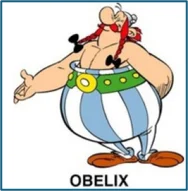
OBELIX as a Community trade mark for firearms, ammunition and explosives?
That must also have been what the Polish arms manufacturer “Works 11 Michał Lubiński” thought when it applied for the Community trade mark “OBELIX” in 2022 for “firearms, ammunition and explosives”. Now you might think, ‘oh, the buyers of weapons (mostly governments or hunters) won’t make a mistake by purchasing a comic book’, or will they? So, based on criterion (i) ‘confusion’ due to (near) identity, it will probably ‘blow over’…. But there are further criteria in trade mark law for invalidating a later trade mark, such as (ii) unfair advantage or (iii) detriment to a trade mark, which is even more relevant in the case of (iv) ‘well-known trade marks’.
The EUIPO found that the arms manufacturer was absolutely right and that there was no risk of confusion, unfair advantage or detriment to this well-known cartoon character trademark; thus, the publisher and trademark owner of ‘OBELIX’ lost the case regarding damage caused to the reputation of its cartoon character trademark. However, it lodged an appeal with the General Court.
What was the EU General Court’s ruling?
Objections were raised back and forth between the publisher and EUIPO. For instance, EUIPO found that the publisher had not sufficiently demonstrated the reputation of the earlier trade mark. However, the EU General Court reminded EUIPO that the reputation of a trade mark must be assessed by taking into account all relevant factors of the case, although none of those factors need, on their own, be sufficient to demonstrate this.
The Court of Justice found that EUIPO’s assessment of the reputation of the OBELIX trade mark was based on an incomplete and incorrect analysis. The EUIPO had failed to take sufficient account of examples of various products on which the term ‘OBELIX’ or ‘OBÉLIX’ appeared accompanied by the ® symbol, indicating that it is a registered trade mark.
It was also wrong to disregard evidence showing that that sign had been used in combination with the Asterix sign. That connection does not preclude the finding that the term ‘OBELIX’ is perceived separately, as an independent trade mark, which may have built up a reputation; (here, for example, via international trade mark No 373128 =>)
The General Court found that EUIPO had not sufficiently examined the link between the two trade marks in question, such as, for example, that the relevant public associated the trade marks with one another, which could damage the reputation of the earlier trade mark. Such an assessment must not – as EUIPO wrongly did – be limited to establishing excessive differences between the goods and services in question or the absence of any overlap between the relevant target groups (Case T-24/25 of 13 May 2026).
The General Court found that the EUIPO had failed to sufficiently examine whether the reputation of the earlier mark could be damaged. Such an assessment must not – as the EUIPO had wrongly done – be limited to establishing excessive differences between the goods and services in question or the absence of any overlap between the relevant target groups.
In short: the later Polish trade mark for firearms and the like could not be registered as a trade mark.
What does this applied standard remind us of?
In particular, the applied standard of “excessive differences between the goods and services concerned” reminded me of an old case of 1 March 1975 from the Benelux Court of Justice (Case A/74/11). This case involved the younger trade mark for a household cleaning product “Klarein” owned by Colgate-Palmolive, pitted against NV Koninklijke Distilleerderijen Erven Lucas Bols with its trade mark for a ‘spirits drink’ (jenever) named “Claeryn”. The Claeryn trademark for “young jenever” was a very well-known brand in the Netherlands from the 1960s to the 1980s and prevailed over “Klarein”.
In 1975 (in its very first ruling ever), the Benelux Court of Justice ruled that a trademark owner did not have to demonstrate that there was direct confusion regarding the origin of the product. Even in the case of non-competing goods, the use of a similar name may be prohibited. In other words: the similarity of the brand names was accepted despite the significant differences between the goods in question (as in the Obelix case). The association that one was ‘drinking a cleaning product (such as “soap gin”) as an aperitif’ proved to be Klaarrein’s undoing.
In short
If you have a trade mark that is registered in a different class for a product or service, but which could be negatively associated with a new and younger trade mark in a different class, you may still have a chance of prohibiting that new trade mark.
Questions
Do you have any questions regarding this article? Our solicitors are ready to advise you! Please contact one of our solicitors via email, by telephone or fill in the contact form for a no-obligation initial consultation. We are happy to help you find a solution.